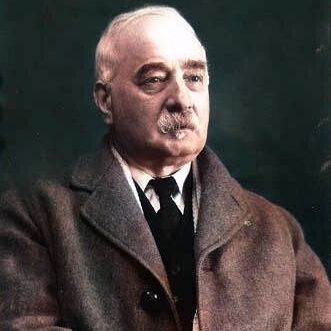
Gari Melchers
A Portrait of an Influential American Artist
Gari Melchers was born Julius “Garibaldi (after the Italian patriot)" Melchers in Detroit, MI on August 11th, 1860. His best-known works include “The Arts of War" and “The Arts of Peace” murals in the rotunda of the Library of Congress, Washington, D.C.
Melchers' work contributed to a general increase of interest in the fine arts within the United States.
Gari was the son of German immigrants, Julius Theodore Melchers and his wife, Marie Bangetor. The senior Melchers was himself a German-born American artist, trained in Paris as a sculptor. He contributed decorations to the Crystal Palace in London, created carved figures for City Hall in Detroit, and became a sought-after maker of cigar-store Native American statues. Gari was one of his father's drawing students and showed talent at an early age. When he became older, he was eager to study the arts abroad. Rather than send the impressionable young man to Paris, the popular destination for American students at the time, his parents elected to first enroll him in a more conservative academy, Kunstakademie Düsseldorf, in Germany. Beginning in 1877, Melchers spent four industrious and productive years developing his skills at the academy.
After Germany, Melchers studied at the Academie Julian in Paris, France. His exposure to the French arts of the 1880s may have helped to lighten the darker color palette that was part of his training in Germany. Melchers learned from both French and German masters the current trend of the time, which was depicting the "nobility of common folk " in their works. In Gari's case, he favored portraying subjects such as sailors, fishermen, peasants, and country maids. Melchers' preference for scenes of rural life found its fullest expression when he took up residence in Egmond, Holland, where he joined his American colleague, painter George Hitchcock.
Some of Melchers' best-known images deal with religious aspects of villagers' lives. This is demonstrated in the various attitudes and expressions of the church attendees in “The Sermon" (1886, National Museum of American Art, Washington, D. C.), a painting that won an honorable mention award at the Paris Salon. Even more concrete expressions of religious devotion and spirituality were found in his paintings that portrayed events within the Life of Christ. The door above Melchers' studio in Egmond, Holland was inscribed with the words “Waar en Klaar", (English translation: True and Clear), a summary of his artistic aesthetic principles.
Melchers' work would gradually change in both palette and brushwork. A fundamentally naturalistic approach remained at the heart of his work which brought him continued success throughout his life. Although he lived for more than twenty years in a small town on the edge of the North Sea, Melchers exhibited his work worldwide. Along the way, he gained numerous honors and medals. He was commissioned to execute murals for the 1893 World's Columbian Exposition in Chicago, the Missouri State Capitol, and the Library of Congress, for which he chose the somber subject of “The Arts of War and The Arts of Peace". The artist and his wife, Corinne (Lawton-Mackall) (m. 1903), were themselves touched by the vagaries of war. Due to the outbreak of World War I, Melchers was forced to leave a teaching position at the Weimar Academy, in Germany. He held the role from 1909 until the eve of U. S. involvement in the conflict.
Upon returning to America in 1914, Melchers kept his New York studio and made his country house, Belmont, a colonial-era house overlooking the Rappahannock River near Fredericksburg, VA., his main home. The north side of Belmont was built in 1790. Before Melchers purchased the home in 1910, it also had previously been bought by Joseph Ficken in 1823. Ficken was the owner of Bridgewater Mills in the City of Fredericksburg, a water-powered (by water wheel) flour mill operation on the Rappahannock River. Ficken extensively added on to Belmont during his period of residency to accommodate his growing family, totaling 6 children.
The location of Belmont and the nearby countryside inspired many of Melchers' later works. Several portrait commissions also came his way at this time, including a portrait commission of American banker, businessman, industrialist, philanthropist, art collector, and politician, Andrew Mellon (1930, National Gallery of Art, Washington, D. C., Special Collection). Through the connection of his wife Corinne, (who hailed from a prominent Baltimore, Md. family), Melchers was asked to serve as an advisor to the Telfair Academy and assist with the acquisition of numerous works. He served as chairman of the Smithsonian Institution commission on the formation of a national art museum (now the National Museum of American Art). In addition, he was active on the Boards of the Corcoran Gallery in Washington, D. C., and the Virginia Museum of Fine Arts in Richmond, VA.
Good-natured and down-to-earth, Melchers was beloved by his colleagues and country neighbors alike. While his neighbors often knew little about his work, colleagues celebrated his achievements in several one-man exhibitions. Melchers did not imitate the works of Symbolists, Post-Impressionist, Juste Milieu, German Religious, or other various artists. Instead, he assimilated and transformed many aspects of their art into his own distinct conservative style.
Gari Melchers died at his home, Belmont, (Fredericksburg, VA) on November 30th, 1932. The house was gifted to the state of Virginia by his widow, Corrine Melchers, in 1942. It is now operated as a museum by the University of Mary Washington. The house was also declared a National Historic Landmark in 1965. Belmont was selected for this nationwide designation to recognize and commemorate Melchers' influential role in bringing American art to European attention. The museum is home to around 1,600 works of art, about 500 of which are Melcher's paintings. Other works of art include his sketches, his studies, works by other artists from Mr. & Mrs. Melchers' personal art collection, and paintings by his wife.
EXHIBIT: GARI MELCHERS
“The Arts of War”
and
“The Arts of Peace”
Rotunda of the
Library of Congress, Washington, D.C.
© Copyright. All rights reserved.