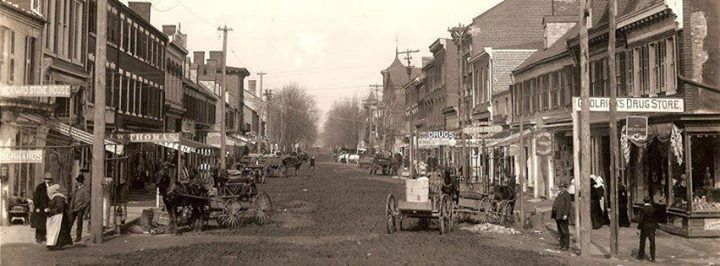
THE HISTORY OF FREDERICKSBURG, VIRIGNIA
The City of Fredericksburg was established by an act of the Virginia General Assembly in 1728, on land originally patented by John Buckner and Thomas Royston of Essex County in 1681. It was named for Frederick, Prince of Wales (1707-51), the eldest son of King George II of Great Britain and father of King George III. Its older streets still bear the names of members of the British royal family.
Settlement to Society
(1607 - 1750)
During the seventeenth and eighteenth centuries, settlement in Virginia spread west from the Tidewater region along the navigable rivers into the Piedmont. Already entrenched in the tobacco economy, settlers laid out sprawling plantations along the fertile soils of the riverbeds. Although the establishment of these large plantations engendered a dispersed, decentralized community, a number of small towns began to emerge as tobacco shipment inspection sites. One of the earliest written accounts of European exploration along the Rappahannock River dates to 1608, at which time Captain John Smith journeyed to the falls and encountered indigenous Native American settlements. The region was visited intermittently by explorers during the next several decades, and, in 1671, a patent was granted to Thomas Royston and John Buckner from Sir William Berkeley for 1 50-acre tract at the falls of the Rappahannock River. Forty colonists subsequently settled on this tract in what is now the commercial core of Fredericksburg. Fredericksburg's first grid plan was drawn up in 1721, and in 1727, the settlement received an official charter from the House of Burgesses and was named in honor of Frederick, Prince of Wales.
An inspection station was set up at the foot of present-day Wolfe Street and a cluster of wood-frame warehouses was hastily erected along the river. The organization of the town coincided with a large upswing in the plantation economy. By 1727, land holdings increased 60% and tobacco exports reached an all-time high. The population of Fredericksburg grew gradually, attracting merchants and artisans, and, in 1732, the town was eventually established as the seat of Spotsylvania County.
The town grew rapidly, and, in 1739, additional land was purchased to accommodate this burgeoning population. Although the town of Falmouth, directly across the river from Fredericksburg, achieved more rapid, prosperous growth during the early days of settlement, the opening of a ferry service between Fredericksburg and Stafford in 1784 solidified its dominance as a thriving port and commercial center. The ferry service allowed farmers and plantation owners to transfer their crops directly to awaiting ships. Along with the warehouses, taverns and other small commercial ventures soon established themselves along the grid plan of the present-day commercial core.
In addition to commercial prosperity, the foundations of government and religious institutions were being laid in settlements across Virginia. During the early eighteenth century, the seat of justice in Germanna, a German settlement 18 miles north of present-day Fredericksburg focused around an iron foundry, relocated to Fredericksburg. Similarly, St. George's parish, also originating in Germanna, established a church in Fredericksburg, electing Rev. Patrick Henry, uncle of the famous orator, as its first rector.
Early National Period
(1789 - 1830)
The Early National Period was a time of significant growth for Fredericksburg's commercial district, reflecting a major shift in Virginia from an exclusively agrarian society toward a more diverse landscape of well-developed towns and cities. Although Fredericksburg was no longer a major port of entry for European exports, trade with the interior hinterlands was strengthened during this time, particularly after the loosening of British restraints on trade after the War of 1812. After 1789, farmers along the Rappahannock River transitioned away from a tobacco-based economy and began diversifying their crops. Along with this shift came the establishment of grist and flour mills in Fredericksburg to process the raw materials coming through along the river. The finished products were shipped to such cities as New York, Philadelphia, and Baltimore or distributed to local merchants in the commercial district. In 1816 alone, 160,000 barrels of flour were handled in Fredericksburg. The area also continued to serve as a major inspection point for these products as well as an “Early National Period" site for goods traveling over the interior roads. During the first half of the nineteenth century, Fredericksburg was the principal center of trade and commerce for the region lying between the Rappahannock River and Orange, Culpeper, Madison, and Fauquier counties.
The disestablishment of the Anglican church in Virginia, along with the rise of other religious denominations, led to the construction of new churches, which were often sited at the center of already established and newly emerging towns and cities. Likewise, the expanding, newly established government called for the construction of new town halls and courthouses.
Pre-Civil War Period
(1830 - 1860)
The pre-civil war period in Virginia is marked by significant internal improvements funded by the Virginia Board of Public Works. Large-scale construction of railroads and turnpikes trumped the growth of the waterway system, upon which Fredericksburg's prosperity was heavily dependent. Despite the improvements in roads and the transition to the railroad as the dominant form of transportation, Fredericksburg held to its vision of a series of canals, locks, and dams that would improve transportation routes to and from the city. Funds, however, proved difficult to raise, and not until 1849 was the first in the series of canals complete. By this time, the canal was made obsolete by the railroad. The city was bypassed on the railroad line from Washington, D.C., to Richmond, severely curtailing the prosperity of area merchants.
Civil War
(1861 - 1865)
Fredericksburg played a major role in the Civil War, serving as the grounds for what was then the largest battle in America and the first urban battle since the Revolutionary War. On December 11, 1862, the Union Army of the Potomac, after bombarding the town with artillery fire, crossed the Rappahannock River and landed at the foot of Hawke Street. The Union Army charged into town and ransacked homes and businesses searching for Confederate soldiers. Caroline Street became a stronghold for the Confederates and thus received the brunt of the battle which extended south to William Street. Several churches and dwellings, including Federal Hill at 501 Hanover Street, were used as makeshift military hospitals, and the basement of the town hall served as a refuge for slaves during the battle. By nightfall, the Confederate Army retreated to Marye's Heights to the south of the town. Two days later, on December 13, a second assault was mounted at Marye's Heights. Confederate soldiers were strategically placed behind a stone wall along the Sunken Road. The battle resulted in significant casualties for the Union Army. The entire Battle of Fredericksburg resulted in 12,653 Union casualties and 4,201 Confederate casualties.
Reconstruction and Growth
(1865 - 1917)
The period of reconstruction in Fredericksburg following the Civil War is marked by a struggling economy and slow growth. The collapse of the plantation system severely impacted the city's economy, as it relied heavily on trade with the rural interior. Like other urban areas, Fredericksburg sought to establish a greater industrial base for the city. While the canal system that was expanded in the 1850s paved the way for water-powered mills and factories, it was not until the arrival of the railroad in Fredericksburg in 1872, along with capital from northern investors, that industrial activities began to surge and transform the city. Factory workers and free blacks settled heavily in the working-class neighborhoods surrounding the factories, while those with newly acquired wealth constructed stately mansions in the developing neighborhoods to the west of the city.
World War I to World War II
(1917 - 1945)
Manufacturing remained the mainstay of the Fredericksburg economy into the twentieth century. Local agriculture simply had not recovered after the Civil War. During the 1920s, the rural county of Spotsylvania could not even provide sufficient food for the local populace. The County, including Fredericksburg, had to import food and animal feed. The market was certainly present, but the soil could not meet the demand. In 1934, an economic survey of Spotsylvania County observed many fields still left uncultivated.
New Dominion
(1945 - Present)
Throughout the remainder of the twentieth century, Fredericksburg grew exponentially. Construction crews completed the State Route 1 Bypass in early 1946. The bridge across the Rappahannock occurred at Falmouth, where bridges had been constructed since the early nineteenth century. While highways and bypasses were meant to enhance inter-city travel, the dynamics of their presence changed post-World War II development patterns. Automobile production grew enormously after World War II. The Federal Aid Highway Act of 1944 had anticipated this post-war need for more and better roads, but the Interstate Highway Act of 1956 provided the unprecedented funding that made automobile highways ubiquitous. In the 1960s, Interstate-95, which runs north-south, crossed the Rappahannock River upstream of Fredericksburg. Most recently, the Virginia Railway Express made Fredericksburg a convenient place of residence for Washington D.C. commuters. Although Old Town retains much of its turn-of-the-century characteristics, many areas outside of the downtown area have been altered.
With its Native American roots, or the framers of this Nation,
from battles of the Civil War, to embracing new industrial revolutions.
This is what makes Fredericksburg, VA
“Simply Timeless!”.
EXHIBIT:
Farmers Creamery
Fredericksburg, VA.
Milk Bottle
The milk bottle on the top shelf of the wet bar area is from Farmers Creamery, Fredericksburg VA. Founded by a group of farmers in 1914 to produce butter, the creamery began delivering milk and milk products to homes in the area by 1919. Farmers brought milk to the company for pasteurization and bottling. In 1920, the fledgling business produced ice cream and, at one point, even mixed baby formulas. By the mid-1960s, the creamery had become one of the 10 largest milk-processing plants in Virginia and filled more than 10 million milk bottles or cartons annually. Ownership changed hands several times from 1969 until the plant went bankrupt and closed down in the 1970s.
© Copyright. All rights reserved.